
International Bomber Command Centre
 -
- 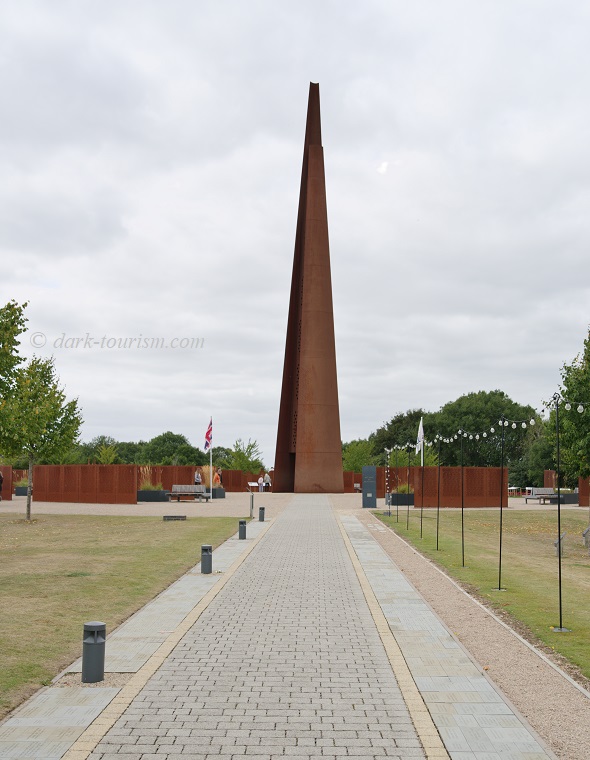 The International Bomber Command Centre (IBCC for short) is a memorial monument complex and visitor centre-cum-museum in Lincoln, northern England, Great Britain, that commemorates the story of mainly British bomber squadrons of WWII (though the USA’s and other nations’ contributions are also acknowledged).
>Combinations with other dark destinations
More background info: A lot has been written about British Bomber Command and the heroism but also controversies surrounding it, as you can find in countless sources – both online and offline. This website cannot compete with all those sources, so only a very brief summery has to suffice here.
RAF Bomber Command was initiated as early as 1936, well before the start of WWII, but initially its resources and manpower were rather meagre compared to the Nazi German war machine. At that point the RAF only had two-engined bomber aircraft that lacked the range, speed and payload capacities to inflict any significant damage on the enemy. Early daylight bombing sorties also proved inefficient and costly, as the bombers available were so vulnerable to fighter aircraft attacks and anti-aircraft gunfire from the ground.
From 1940 a new bombing doctrine was implemented, with night-time aerial bombing (i.e. indiscriminate carpet bombing) of German cities and industrial centres becoming the priority. At the same time newer, heavier bomber planes were being introduced, in particular the legendary Avro Lancaster four-engine heavy long-range bomber.
As the new commander-in-chief of Bomber Command the legendary and, for some, infamous Air Marshal Arthur “Bomber” Harris was appointed. Even though he was installed by Churchill himself, it is usually “Bomber” Harris who is seen as the one primarily responsible for the carpet bombing of civilians in Germany, in which hundreds of thousands died and millions were made homeless.
Another early strategy was also those Dam Buster raids targeting water reservoir dams in the Ruhr area of Germany. These dams perhaps constituted secondary military targets, certainly infrastructure targets, but their destruction also inundated villages inhabited by innocent civilians.
Then came the often “1000-bomber” raids, sometimes lasting several days, against major cities like Cologne, Hamburg (see Nikolaikirche memorial) and Berlin, especially from 1943 onwards, creating firestorms, mass death and devastation.
By 1944, with Allied air superiority, joint RAF and USAF bombing raids (with the RAF usually flying at night and the Americans by day) targeted more and more German cities, some of which were over 90% destroyed (such as Würzburg).
The most controversial name in this context, however, has to be Dresden, which in February 1945 was severely bombed, at a time when the war was more or less lost for Nazi Germany anyway and when tens of thousands of refugees had fled to the city, which was known as the “Florence of the Elbe”.
This is why some historians regard Arthur “Bomber” Harris as basically a war criminal, though that’s still only a minority view within Britain. What definitely didn’t work out was what was given as the main justification and aim for the massive bombing of civilians: namely that it would break the Germans’ “morale”. It did not, by and large, rather on the contrary.
The bombers and their crews, on the other hand, also paid a very high price. In fact, service in Bomber Command came with a lower chance of survival than in the trenches of WW1! According to a chart in the exhibition, out of 100 aircrew in a certain bomber squadron only a quarter to a third survived their period of service, while up to 60% were killed in action and the remainder wounded or taken POW.
It took until 2015 for a specially dedicated memorial monument (see below) to be unveiled honouring the sacrifices made by the bombing crews. This memorial site is just south of Lincoln in northern England, near the bomber station (RAF Waddington) that suffered the highest losses in WWII – and also not far from the place where one of the Avro aircraft factories was located.
In April 2018, coinciding with the centenary of the founding of the RAF, the current visitor centre and museum exhibition were opened.
Even though the RAF is the main focus here, the role played by the USA and a whole range of other nations (including many Poles and even Germans who had fled the Nazis) is also covered.
What there is to see: As you approach the main building from the car park you first pass a rather kitschy monument featuring an aluminium-silver Avro Lancaster bomber model (ca. 1:20 scale) atop a plinth on which silhouettes of women and children are cheering and waving at the plane overhead … as if it was the Berlin airlift. Oh well.
Inside the main building you first enter a bright and airy two-storey-high atrium where you’ll find the ticket desk.
Within the main exhibition ambient light is low and the walls blackened (very much a trend in recent museology). Exhibits are picked out by spotlights or backlit. There are some intro panels including one of the layout of a Lancaster bomber cockpit. Then there is a side room that serves as a cinema of sorts with a row of seats where you can watch a series of short films (ca. two and a half to three minutes each) about the WWII bombing raids and the aircrews. The films are shown in a loop at intervals. When I arrived the set was just finishing so I carried on into the main hall first and returned for a later screening.
The main hall is dominated by a huge screen on the far wall; here animations show the development of the bombing campaigns of WWII in Europe in chronological order (i.e. including initial German bombings of Britain). Some footage of the infernos created by firebombing are interspersed too.
The second largest element in the main hall is a kind of interactive media table about a Lancaster mission. Here you can, amongst other things, practise your aim at firing back at fighter planes attacking the bomber. It’s more for the kids really …
Along the side walls, rows of text-and-photo panels detail a day in the life (in 1944) of a bomber squadron, from aircraft prep to briefing and from take-off to enemy contact and bombing, and to the return flight – if they did return. The many losses are highlighted too. Dotted about there are also small screens with video material, but mostly the displays are static (and, as you would expect in Britain, monolingual, in English only).
One panel also doesn’t shy away from addressing the controversy surrounding the systematic aerial bombing of German cities. While a majority in Britain thought the Germans deserved it, some disagreed and disapproved of the fact that such mass killing of civilians be carried out in their name (the author Vera Brittain having been amongst the most vocal of these dissenting voices).
Civilian life under the bombs is covered too, especially what it meant for children – on both sides. The case of Dresden (see also above) is another problematic aspect picked out on one panel.
A couple of statistical panels are quite illuminating: one shows the relative numbers of survivors and casualties in one Lancashire-based bomber squadron, where only 25% of the crews managed to survive and complete their “tour” (i.e. the predetermined number of sorties crew members were supposed to fly before being replaced). Another compares the total tonnage of bombs dropped by Nazi Germany on Britain – 74,000 tons – with the total dropped by the RAF and USAF over Germany: 1.500,000 tons! (And that’s just those dropped on Germany within its original borders; if you include the bombs dropped on the occupied territories, especially France, and Italy, the figure almost doubles.)
After the war, some people, including Churchill, distanced themselves from the bombing of civilians – and Bomber Command ex-aircrew often avoided talking about their wartime experiences, as they felt there was a certain stigma of having been “killers of civilians”.
Another panel places the focus on survivors who had to make their way through enemy lines after having been shot down (although most were captured and taken POW), or on those who had to bail out over water and then had to await rescue there (informally they were known as “Goldfish”), while those wounded and disfigured underwent experimental plastic surgery and called themselves “Guinea Pigs”.
Some panels point out that Bomber Command missions weren’t all about destruction, but there were also a few “humanitarian ones”, such as “Operation Manna”, in which vital food supplies were airdropped over the Netherlands to alleviate food shortages and prevent starvation. Rescue operations to bring home POWs was another such non-destructive element.
Artefacts on display are very few, including some of the lucky charms that aircrews carried with them on their sorties. There are also some musical instruments associated with crews and used during leisure time between missions.
A few physical (rather than digital) interactive elements include decoding aircrew slang or preparing/fitting a Lancaster bomber. Again, it’s more for the kids.
A separate section looks at the home front, both in Britain and in Germany and Nazi-occupied territories such as France, with a special focus on resistance movements.
As has become common over the years in museums of this sort, there’s also a special angle of looking at certain individual stories of people involved in some way. This is probably to make things more relatable.
Upstairs is a separate section about commemoration of Bomber Command and another looking at the post-WWII legacy of bombing throughout the Cold War and its proxy wars and up to the modern day with drones and AI-driven technology.
Outside, the open-air part of the memorial complex is dominated by a tall rusty metal spire that serves as the central monument to Bomber Command. It’s ringed by rusty metal panels detailing the names of all members of Bomber Command who lost their lives during active service.
The approach path between the museum building and the main memorial is flanked by countless memorial plaques set into the ground to the left and right. This is called the “Ribbon of Remembrance”. The crews/individuals thus commemorated include not only those from WWII, but there are also numerous ones for Avro Vulcan crews of the Cold War and even Tornado crews in the Gulf War or other more recent conflicts.
Near the main monument and names panels is another set of open-air text-and-photo panels dedicated to women in war (installed only in March 2025), yet another honours volunteers from the Commonwealth (Canada, Nigeria, India, etc.).Yet another picks out a number of veterans.
There’s also a Jewish memorial, an engraved sarcophagus-like stone monument covered with pebbles (as is the Jewish tradition of leaving mementoes). A panel next to it simply says “Lincoln Jewish Memorial Stone – may their memory be for a blessing”. The associated QR code for accessing more information, however, did not work as it had become too rusty. So I cannot say anything about the background to this particular memorial.
To the right is a field of poppies (not real ones but ceramic or metal replicas) in the midst of which is a structure that from on the ground doesn’t look like much, but a panel with an aerial view reveals that the poppies in the centre of the field are arranged in such a way as to form the silhouette shape of a Lancaster bomber when seen from above.
Back in the main building’s atrium you can browse around the large museum shop, which offers the usual range of books, brochures, plastic aircraft model kits, toys, items of clothing, mugs, and trinkets of all sorts. The range here is really quite wide. In addition there is also a museum café (called “The Hub”).
All in all, even though the darker and more problematic aspects of the Bomber Command campaigns are not entirely omitted, but duly noted on the odd text panel, the much more prominent focus of most of the exhibition and the memorial monuments is clearly on the glamourization and hero worship of the bombing crews and associated figures. This bias is perhaps not quite as stark as at other WWII-related sites in Great Britain (such as the Battle of Britain Memorial) but still quite palpable. For me that docks it a couple of points/stars.
Location: off Canwick Road (B11888) a few miles south of Lincoln, England, Great Britain. Postcode: LN4 2HQ.
Google Maps locator: [53.2139, -0.5291]
Access and costs: not too difficult to get to, at least by car; mid-priced.
Details: to get to the IBCC ideally you should have a car. Take the Canwick Road (B1188) south of Lincoln, and at the Premier Inn and pub/restaurant turn right and right again into the access road, Heighington Road, which leads straight to the car park.
Alternatively you could also get a regional train to Lincoln and from the station get a taxi (ca. 5 minutes) and back. Given the demand for taxis at certain times it would probably be best to arrange a taxi in advance.
In theory you could also walk it from the station – but it’s not the most scenic or pleasant route (takes about half an hour). From the station head east along Oxford Street and then turn right on to Canwick Road and carry on all the way to the memorial. There is a side entrance on the right to the car park avoiding the long loop along Heighington Road, but that’s only open seasonally (closed in winter and in inclement weather).
There are also buses going there from the central bus station (lines 31X and 2), but how convenient these may be I cannot say.
Opening times: Tuesday to Sunday from 9:30 a.m. to 5 p.m.; in winter (mid November to mid February) only to 4 p.m. (last admission to the exhibition an hour before closing). Closed on Mondays except for Bank Holidays. Also closed between Christmas and New Year.
Admission: 12.50 GBP on the door, 11.50 GBP if purchased in advance online; some concessions apply.
The car park (pay-and-display) charges additional fees.
Time required: I spent just under an hour at this site, but I was in a bit of a hurry as I had a busy itinerary. I could probably have spent two hours there had I skimmed the exhibition less. If you want to use all the interactive elements and read absolutely everything that’s available, you’d probably need even longer than two hours. I’ve seen reviews in which people claimed to have spent five hours at this site!
Combinations with other dark destinations: nothing in the immediate vicinity, but if you’re travelling by car there are a couple of further dark sites within an hour’s drive or so, such as the National Holocaust Centre & Museum or the Southwell Workhouse.
For more further afield see under Great Britain in general.
Combinations with non-dark destinations: Lincoln is famous mostly for its grand Gothic Cathedral, one of the greatest such edifices in the British Isles (and allegedly once the tallest building in the world!). But the small city also has a few other attractions.
In general see also under Great Britain.


